Artwork:
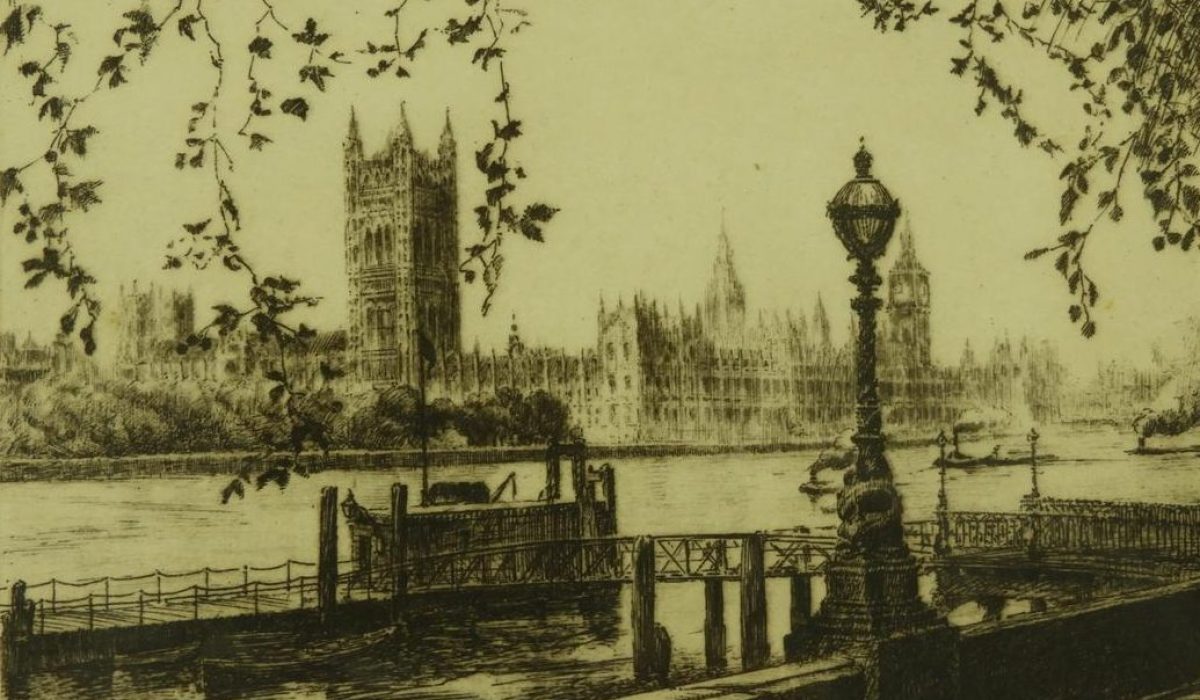
Edward J. Cherry. Untitled. Etching. No date.
This finely executed etching by the artist presents a tranquil yet grand view of the River Thames, with the monumental silhouette of the Palace of Westminster rising in the distance. Seen from the riverside embankment, the composition frames the Gothic Revival towers of Parliament and Big Ben—across the broad sweep of water.
Cherry employs a delicate network of etched lines and soft tonal passages to evoke atmosphere. Overhanging foliage frames the upper margin of the composition, its trailing vines and leaves creating a natural arch that both softens and encloses the architectural vista beyond.
Artist:
1886-1960 → Edward J. Cherry was an English-born etcher known for his finely observed architectural and landscape subjects rendered in a realist style. Working primarily in etching and drawing, Cherry produced detailed depictions of historic streets, mills, and notable buildings, often reflecting an appreciation for European and British architecture.
Cherry’s artistic practice was shaped in part by his experiences during the First World War, when sketching and drawing were encouraged as a therapeutic activity during recovery in hospital. During this period, he created numerous sketches of his surroundings, developing a disciplined approach to observational drawing that informed his later etchings.
Cherry was born in England in 1886 and trained in the family photographic and framing business alongside his brother Arthur L. Cherry. He immigrated to Canada in 1907 and worked as a picture framer in Vancouver, later operating his own framing business.
He married Frances Heskett in Vancouver in 1915, and that same year enlisted in the 103rd Battalion of the Canadian Overseas Expeditionary Force, departing from Victoria in 1916. During the First World War, he spent an extended period recovering in hospital after being exposed to poison gas.
Cherry continued his artistic work and maintained connections in both England and Canada following the war. In 1928 he was elected a Fellow of the Royal Society of Arts. He exhibited in group exhibitions notably two in 1932 – the Vancouver Sketch Club exhibition at the Vancouver Exhibition and the BC Artists 1st Annual at the Vancouver Art Gallery. Cherry worked as a self-employed artist until he retired in 1952. Having lived in Vancouver for more than five decades, he died there in 1960 at the age of 73.
Deep Dive:
BBC article: Glasgow Nurse’s Lost Book Reveals WWI Art Therapy for PTSD.
More info on Edward Cherry’s family: The Cherry Brothers of St. Albans.
Foundation:
The Canadian Art Preservation Foundation posts short biographies and information on artists and artwork from its collection in a not-so-subtle attempt to capture your attention and interest in our mission, but we also just want to keep this artwork in view. We are excited about the art we collect and want to share it with you.
CAPF is a non-profit organization dedicated to preserving the artwork of Canada’s superstar artists for future generations to examine, study and exhibit – the ones you know and the ones you might not know so well. We accept artwork, journals, notes, letters, exhibition catalogues and anything else that might comprise a visual and/or intellectual “portrait” (ahem, please pardon the pun) of a particular artist.
View more artwork from our CAPF Collection and if you’d like, Donate Here.
We archive, preserve and promote Canadian art.