
Artwork:
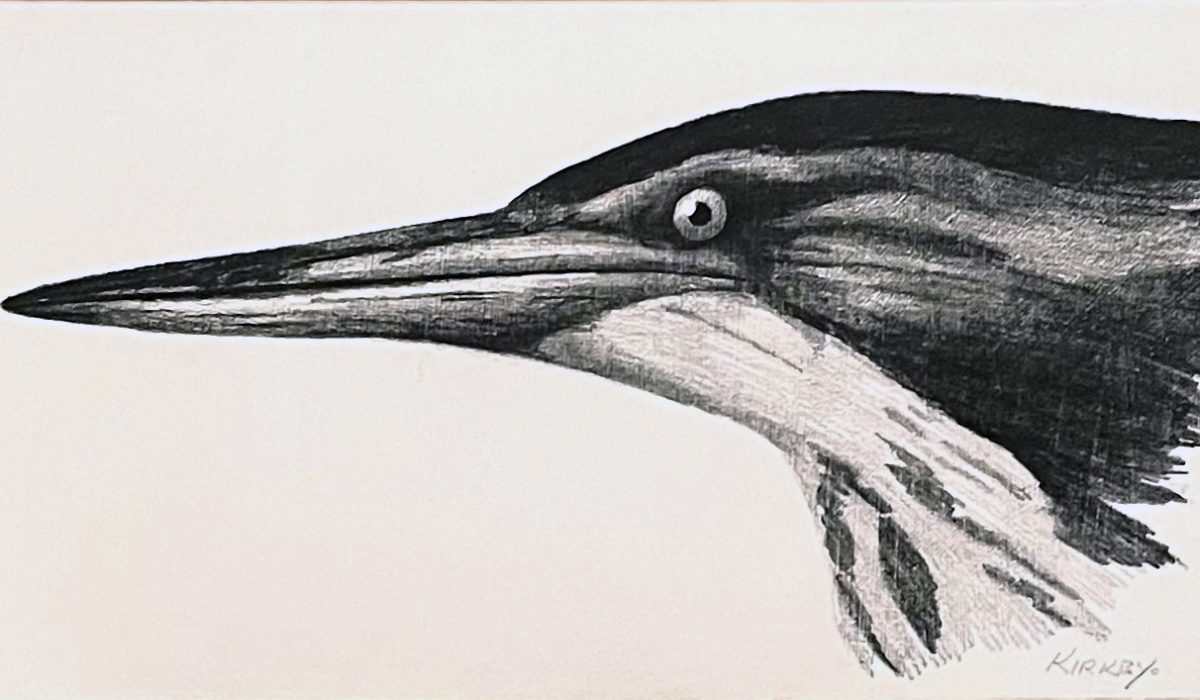
Ken Kirkby. Untitled (Speckled Wren). Graphite on paper. No date.
A stark, monochromatic study captures the alert profile of a speckled wren, rendered with economical yet expressive strokes. The fine, pointed beak extends with precision, while the bright, attentive eye anchors the composition in a moment of quiet vitality. Layered, gestural marks suggest the bird’s mottled plumage, with darker passages defining the head and back against the lighter, textured throat.
The composition remains immediate and unembellished, emphasizing character and presence over intricate detail. Negative space is used with restraint, allowing the small bird to emerge with clarity and strength. The result is both an intimate observation and a distilled, almost calligraphic evocation of the wren’s restless energy.
Artist:
1940-2023 – Ken Kirkby was a painter whose artistic practice was deeply rooted in lived experience, environmental awareness, and a commitment to social advocacy. Working primarily in oil on canvas, he is best known for his sweeping landscapes of the Canadian Arctic and West Coast, often featuring the Inukshuk as a central symbolic form. These stone figures, which he encountered while traveling with Inuit communities, became a defining motif in his work—representing survival, guidance, and the enduring presence of Indigenous culture on the land. Kirkby’s years spent walking, paddling, and sledding across the Arctic shaped both his visual language and his purpose as an artist. Inspired by his close relationships with Inuit people, Kirkby saw art as a vehicle for raising awareness about northern social issues. His ambitious project Isumataq, the world’s largest oil-on-canvas painting, exemplifies his fusion of artistic vision and strategic communication, using scale and spectacle to engage a broader public with the realities of the North. Later in life, his focus shifted toward environmental concerns, particularly the decline of salmon populations, continuing his lifelong belief in art as a tool for advocacy.
Born on September 1, 1940, during an air raid in London, England, Kirkby’s dramatic beginnings foreshadowed what he would later describe as his path as a “warrior-painter.” Raised in Portugal, he held his first exhibition at age sixteen in Lisbon, where it sold out and received critical acclaim. Political unrest prompted his move to Canada in 1958, where he eventually traveled extensively through the Arctic for five years. His early success in Canada came in the 1960s and 70s with Western landscape paintings, though recognition of his Arctic-focused work followed later with the creation of Isumataq, unveiled in 1992 at the Canadian Parliament and subsequently exhibited in Ottawa, New York, and Ontario Place, where it drew over one million visitors. In 1993, he was awarded the Commemorative Medal for the 125th Anniversary of Canadian Confederation. Kirkby’s work is held in major public and private collections, including those of members of the British Royal Family, former Prime Ministers Jean Chrétien and Pierre Elliott Trudeau, and the National Gallery of Canada. Beyond painting, he served as President of the Nile Creek Enhancement Society beginning in 2006, leading conservation efforts in British Columbia. He continued to paint throughout his life, eventually settling on Vancouver Island with his wife, artist Nana Cook, until his passing in 2023.
Deep Dive:
More info on political unrest in 1958 Portugal.
If you have some time, info on Isumataq + video on Kirkby’s speech at the unveiling of Isumataq, Canadian Parliament, September 1992.
Pacific Salmon Foundation’s 2025 State of Salmon Report. + the Nile Creek Enhancement Society website.
Foundation:
The Canadian Art Preservation Foundation posts short biographies and information on artists and artwork from its collection in a not-so-subtle attempt to capture your attention and interest in our mission, but we also just want to keep this artwork in view. We are excited about the art we collect and want to share it with you.
CAPF is a non-profit organization dedicated to preserving the artwork of Canada’s superstar artists for future generations to examine, study and exhibit – the ones you know and the ones you might not know so well. We accept artwork, journals, notes, letters, exhibition catalogues and anything else that might comprise a visual and/or intellectual “portrait” (ahem, please pardon the pun) of a particular artist.
View more artwork from our CAPF Collection and if you’d like, Donate Here.
We archive, preserve and promote Canadian art.


