Artwork:
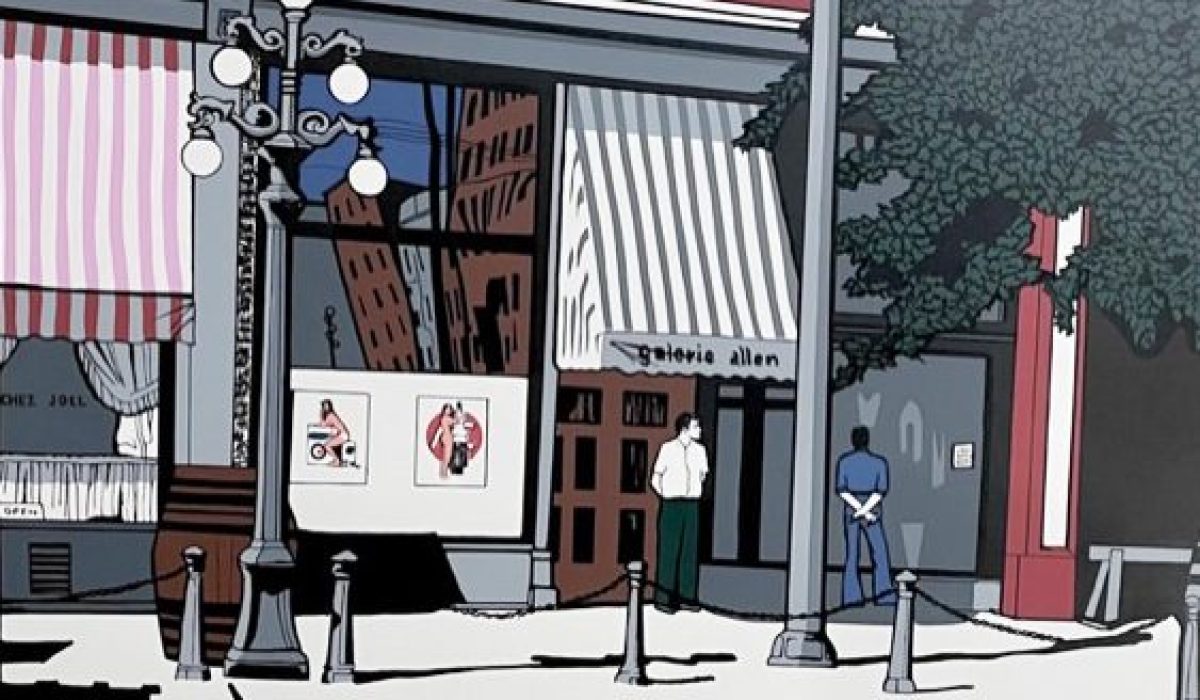
Bill Featherston. Galerie Allen Gastown 1975. Serigraph, 45/100. 1975.
This serigraph presents a sharply observed urban streetscape, rendered with a graphic clarity that reflects the artist’s background in printmaking and his sensitivity to constructed space. The composition is anchored by a storefront façade—identified as “Galerie Allen”—and Featherston employs a flattened perspective and crisp contour lines, creating a stylized, almost architectural reading of the scene. The colour palette is restrained: muted greys and blacks structure the environment, while reds, and pale blues punctuate the image, guiding the viewer’s eye across the composition. Figures are sparsely distributed and curiously detached.
The work gains additional resonance when understood in relation to the history of Galerie Allen. Active in the early 1970s, the gallery was founded by Danish-born gallerist Jytte Allen shortly after her arrival in Vancouver in 1970, at a moment when Gastown itself was undergoing a profound cultural transformation.
At that time, Gastown was emerging from a period of urban neglect into a newly protected historic district and a centre for artistic and countercultural activity. The area’s designation as a heritage zone in 1971 catalyzed an influx of artists, experimental galleries, and cultural initiatives, positioning it as one of Vancouver’s earliest contemporary art hubs. Within this context, Galerie Allen was among the pioneering commercial galleries that helped define the neighbourhood’s artistic identity, exhibiting both Canadian and international artists and championing contemporary practices at a time when such support was still relatively rare in the city.
Featherston’s depiction of the gallery is therefore not incidental but historically situated. The storefront becomes a site of cultural exchange embedded within a rapidly evolving urban fabric. His characteristic flattening of space and careful attention to architectural detail mirrors Gastown’s own layered identity—Victorian façades repurposed for modern cultural use. The restrained yet deliberate composition suggests both the vitality and the quiet tension of the neighbourhood in transition: a place where commerce, art, and everyday life intersect, but where figures remain curiously detached, as if observing rather than participating.
Seen through this lens, the print functions not only as an urban scene but also as a document of Vancouver’s early 1970s art ecology. Galerie Allen stands as a symbol of a formative moment when artist-run culture, commercial galleries, and heritage preservation converged—an environment in which Featherston himself was actively working upon his return to Canada.
Artist:
1927-2009 – Bill Featherston’s artistic practice was marked by a dynamic interplay between abstraction and representation, often infused with strong political and social commentary. He began his career as an abstract sculptor, and his work frequently incorporated architectural references and subtle figurative elements, evolving over time into more representational modes. He worked across mediums including sculpture, painting, and printmaking, experimenting with colour, texture, and symbolic imagery. Throughout his career, Featherston interwove social realism with symbolic and politically charged compositions, addressing themes such as capitalism, imperialism, war, and social injustice. His work reflected a direct and unapologetic engagement with contemporary issues, often using bold visual narratives to critique power structures and human suffering.
Born in Toronto in 1927, Featherston’s early life was shaped by his wartime service after forging a birth certificate to join the Royal Canadian Navy. He served in both the Atlantic and Pacific during World War II. After returning home in 1946, he pursued education through night classes, earning a BA and briefly attending the Ontario College of Art before becoming a teacher. In 1958, he moved to Britain, where he lived, worked, and exhibited for over a decade, immersing himself in a vibrant artistic community and establishing his career. He later spent a short period in the US before returning to Canada in 1971. Over a career spanning more than sixty years, Featherston exhibited widely, with major shows in London, Edinburgh, Toronto, Washington, D.C., and Vancouver, and continued teaching at various institutions without interrupting his artistic production. His work is held in numerous public collections, including the Canada Council, Ottawa Art Bank, B.C. Art Bank, University of Buffalo, Leeds Art Gallery, the Corcoran Gallery of Art, and the University of Glasgow. He died in 2009.
Deep Dive:
More on Jytte Allen, the gallerist behind Galerie Allen, and a condolence page full of photos and stories in response to her death in July 2020.
Foundation:
The Canadian Art Preservation Foundation posts short biographies and information on artists and artwork from its collection in a not-so-subtle attempt to capture your attention and interest in our mission, but we also just want to keep this artwork in view. We are excited about the art we collect and want to share it with you.
CAPF is a non-profit organization dedicated to preserving the artwork of Canada’s superstar artists for future generations to examine, study and exhibit – the ones you know and the ones you might not know so well. We accept artwork, journals, notes, letters, exhibition catalogues and anything else that might comprise a visual and/or intellectual “portrait” (ahem, please pardon the pun) of a particular artist.
View more artwork from our CAPF Collection and if you’d like, Donate Here.
We archive, preserve and promote Canadian art.