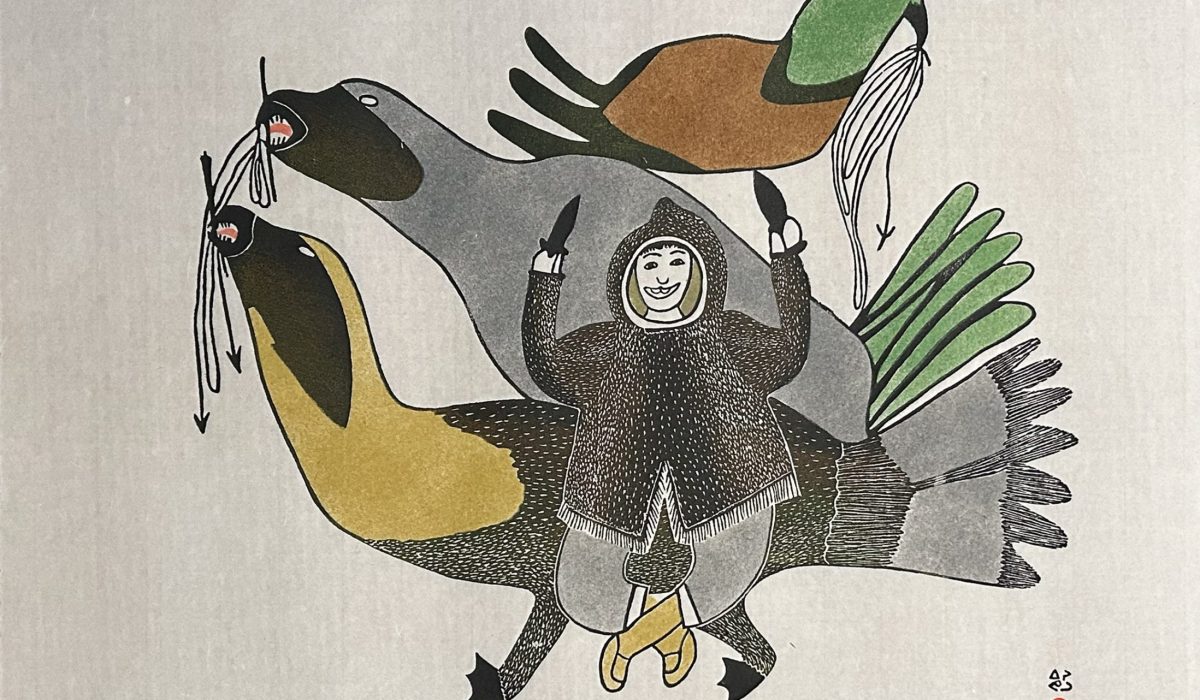
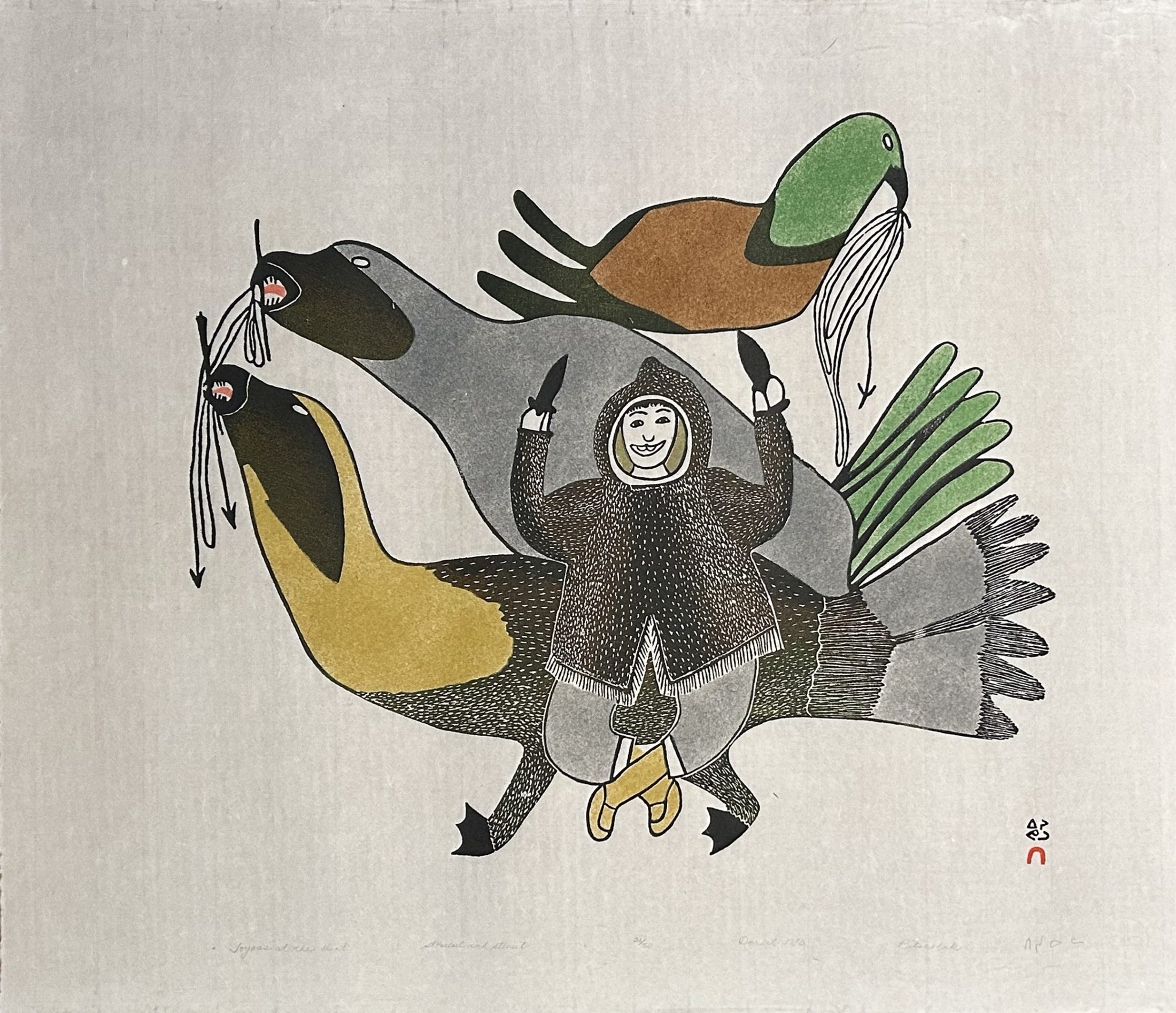
c. 1904-1983 – Pitseolak Ashoona was one of the first Inuit artists to draw for the Cape Dorset print studio, and over two decades she became its most prolific figure, producing between 7,000 and 9,000 drawings, roughly 250 of which were made into prints. She came to art somewhat by accident: after two years sewing and embroidering parkas and mittens for the West Baffin Eskimo Co-operative, she saw the drawings and prints of her cousin Kiakshuk and decided to try drawing herself, initially to earn a little extra money.
Self-taught, she worked freehand, sketching an outline first and then filling it in with rapid, energetic line work, a technique that became a hallmark of her style. She moved from graphite pencil to coloured pencil and felt-tip pen, favoring the latter for the vibrancy that suited what scholars have called the "joyfulness" running through her imagery, and she also experimented, with less enthusiasm, in copper engraving and lithography; in 1975 an arts grant led her to take up acrylic on canvas as well.
Her subject matter drew on two intertwined threads: the everyday textures of pre-contact Inuit life — hunting camps, sewing, travel by dog team and umiaq — and the legends and spirit-beings of Inuit tradition, such as the sea goddess Taleelayu, rendered with an inventive, sometimes otherworldly imagination.
Formally, she is credited with adapting devices from her years as a seamstress, particularly mirroring motifs and dividing the picture surface into registers, into her compositions. Though her own life had been marked by considerable hardship, she said her intention was to preserve "the things we did long ago before there were many white men," and her drawings are notable for favoring good memories over depictions of suffering.
Born on Tujajuak (Nottingham Island), Nunavut to Timungiak and Ottochie, Pitseolak grew up in a traditional, land-based Inuit life, and around 1922–23 she married the hunter Ashoona, with whom she had seventeen children, six of whom she raised to adulthood; several of her children and grandchildren, including Napachie Pootoogook, Kiugak Ashoona, Qaqaq Ashoona, and Shuvinai Ashoona, went on to become celebrated artists in their own right.
After Ashoona's death in the early-to-mid 1940s, she supported her family through years of hardship before eventually settling permanently in Kinngait (Cape Dorset). Her career gained momentum through the 1960s and reached wide recognition in the 1970s: in 1971 she published the book Pictures Out of My Life with Dorothy Harley Eber, adapted in 1973 into a National Film Board documentary of the same name. In 1974 she was elected to the Royal Canadian Academy of Arts, and in 1977 she was made a Member of the Order of Canada. A major retrospective of her drawings toured Canada and the US from 1976 to 1978, including venues such as the National Gallery of Canada and the Smithsonian Institution.
Her work has since been held and exhibited by institutions including the National Gallery of Canada, the Art Gallery of Ontario, the Winnipeg Art Gallery, the Vancouver Art Gallery, and the McMichael Canadian Art Collection, and in 1993 she was honoured posthumously on a Canadian postage stamp marking International Women's Day. Pitseolak Ashoona died in Kinngait (Cape Dorset) in 1983.